Model Shop Licence in UP 2026: Fees, Rules and Your First 30 Days
Published By: Jatin Monga (CEO) on 13 Nov 2026
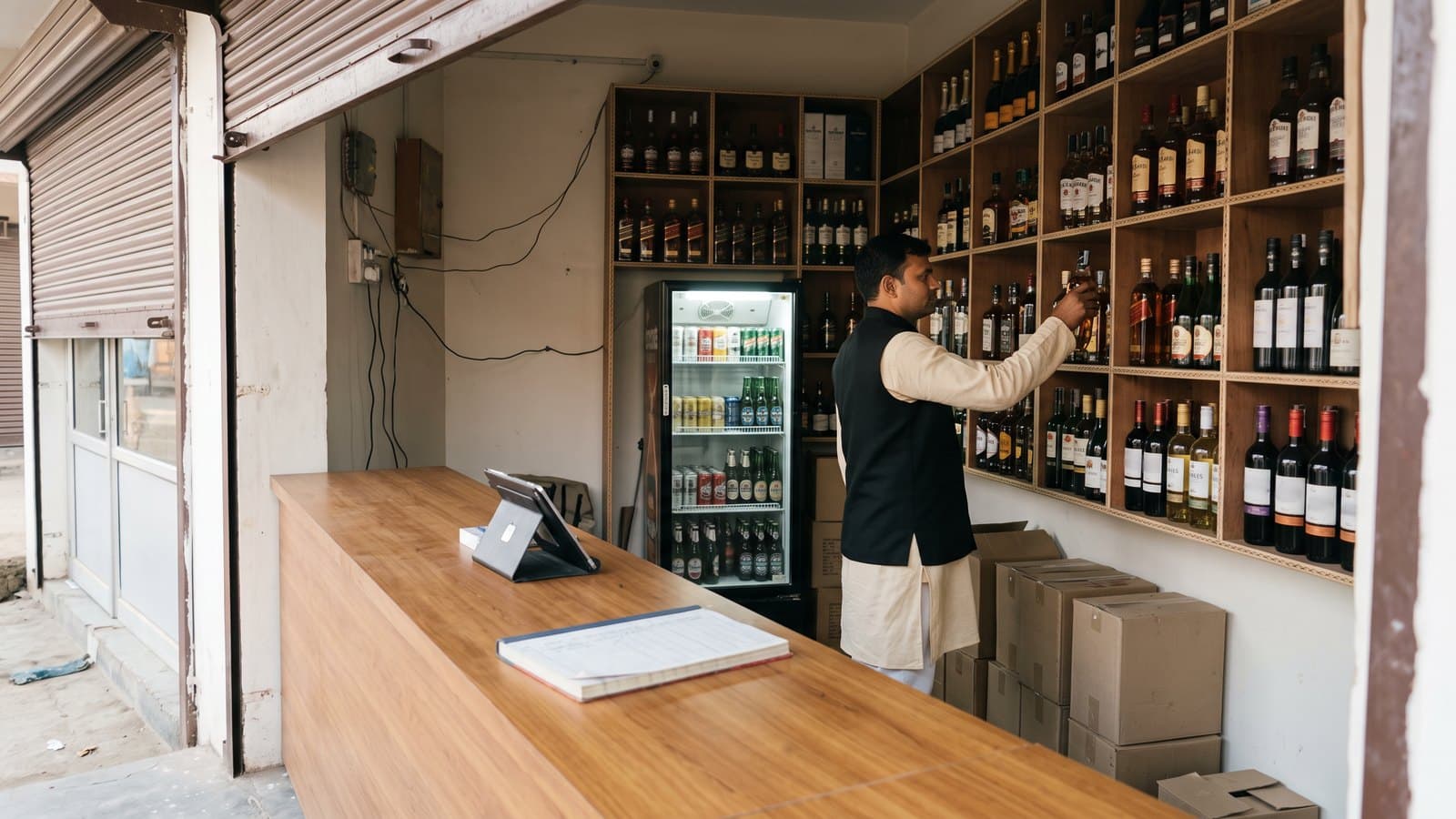
A model shop in Uttar Pradesh is a licensed liquor shop where customers can buy foreign liquor and beer and also drink on the premises. A composite shop sells the same range but cannot let anyone drink inside. That one difference changes the licence, the fees and the way the shop runs every evening.
Most people who search for a model shop licence already hold a composite shop and want to upgrade. Others won a shop in the e-lottery and want to know what comes next. This guide covers both. It uses the UP Excise Policy 2026-27, issued on 12 February 2026, and then walks through the first 30 days of running the shop.
The licence is the easy part to finish. The daily work after it is harder: a busy counter, a sitting area, four registers and a monthly stock report. If you run a composite shop today, you already know half of that work.
What a model shop is, and how it differs from a composite shop
Since the 2025-26 policy, UP has sold foreign liquor and beer from one shop. Separate beer shops and foreign liquor shops were merged into composite shops. The 2026-27 policy calls the composite shop FL-5DB and says plainly that drinking is not allowed at a composite shop.
A model shop sells the same kind of stock and adds a place to drink. For that it pays a yearly drinking fee on top of its licence fee. Here is the difference in short:
Composite shop: sells foreign liquor, beer, wine and low alcohol drinks over the counter. No drinking inside.
Model shop: sells over the counter and lets customers drink on the premises. Pays a drinking fee.
Premium model shop: a large model shop in a city, with its own licence (FL-4AA) and extra conditions.
The policy also sets a minimum carpet area of 400 sq ft for model shop premises in 2026-27.
How to get a model shop licence in UP
There are three routes under the 2026-27 policy. Which one applies depends on whether you already hold a shop.
1. The e-lottery
UP settles retail shops through the excise e-lottery portal. There is no open tender for a model shop. When people search for a "model shop tender in UP", the e-lottery is what they mean. You apply online, pay a non-refundable processing fee, and the draw decides who gets the shop. For the 2025-26 lottery, press reports said one person could not be given more than two shops across the state. Confirm the current limit with your district excise office.
For the wider licence process, documents and eligibility for every shop type, read our UP wine shop licence guide. This post stays on model shops.
2. Renewal
Clause 1.10 of the 2026-27 policy quotes clause 5.11 of the 2025-26 policy. Every shop settled by e-lottery in 2025-26 got the option to renew for 2026-27. Premium model shops also got the option for 2027-28. The state keeps the final say on any renewal. Composite, model and premium model shops went through renewal first, and shops that were not renewed went back to the e-lottery.
To renew, the policy asks for three things:
All dues paid up to the last lapsed month.
The 2025-26 security deposited and intact.
A notarised affidavit on Rs. 10 non-judicial stamp paper, in the format the Excise Commissioner sets.
3. Upgrading a composite shop
This is the route most existing licensees ask about. The 2026-27 policy allows it from the date the policy was issued. If your composite premises meet the model shop conditions, you can ask for your composite shop to become a model shop. You pay the drinking fee, and your licence fee is reset.
Once converted, the composite shop stops existing. You hold a model shop instead. You also pay the processing fee, the difference in licence fee and security, and any other dues.
Model shop licence in UP: price and fees for 2026-27
This is the most searched question, and the answer has several parts. Every figure below is from the UP Excise Policy 2026-27. Your exact fee is set for your shop, so confirm it with the district excise office before you pay anything.
Drinking fee. Model shops and premium model shops pay Rs. 3,00,000 a year. A shop settled midway through the year pays at least six months of it.
Licence fee for an existing model shop. It is the 2025-26 fee plus 7.5%, rounded up to the next Rs. 5,000.
Minimum licence fee for a newly created model shop, by area category:
Category 1: Rs. 75 lakh
Category 2: Rs. 65 lakh
Category 3: Rs. 40 lakh
Category 4: Rs. 35 lakh
Category 5: Rs. 30 lakh
Category 1 covers the Gautam Buddh Nagar authority areas and the nagar nigam areas of Ghaziabad, Lucknow, Agra, Varanasi, Prayagraj, Gorakhpur and Kanpur, plus 3 km around them. Category 2 is other nagar nigam areas plus 3 km. Category 3 is nagar palika areas plus 3 km. Category 4 is nagar panchayat areas plus 1 km. Category 5 is everywhere else.
Security. 10% of the licence fee, the same as for a composite shop.
Processing fee for renewal or an e-lottery application, non-refundable: Rs. 1,00,000 in category 1, Rs. 90,000 in category 2, Rs. 80,000 in category 3, Rs. 70,000 in category 4 and Rs. 60,000 in category 5.
Licence fee after a composite upgrade. The policy links it to the shops around you. If a model shop already runs within 200 metres, your fee cannot be below 80% of its fee. The policy then steps out to 500 metres and 1,000 metres with lower floors. Your fee is never cut below what you paid as a composite shop. It is also raised to the new model shop minimum for your category where the policy says so. The district office does this calculation, so ask them for your figure in writing.
Rules a model shop must follow
A model shop carries a minimum guaranteed revenue (MGR) for the year. For 2026-27 it is the 2025-26 figure plus 7.5%. It is split into twelve equal monthly parts. Unlike a composite shop, a converted model shop does not get separate beer and foreign liquor MGR figures.
In nagar nigam areas and the whole of Gautam Buddh Nagar, model shops have one more rule. Each month they must lift at least 5% of their monthly MGR as imported liquor and at least 2% as premium or higher category IMFL. Plan your stock for this from the first order.
A premium model shop has stricter terms. It must be in a nagar nigam area or a Gautam Buddh Nagar authority area, with at least 3,000 sq ft of carpet area across all floors. Only the two highest revenue shops of this kind in a district get the FL-4AA licence. It costs Rs. 5,00,000 extra and can be renewed up to 2027-28.
Rules on the sitting area itself, such as hours, seating and food, were not in the policy pages we read. Ask your district excise office before you build it.
Your first 30 days of running a model shop
The licence lets you open. The first month decides whether the shop runs calmly or in a scramble.
Week 1: set up the stock and the counter. Load every product with its MRP before the first sale. Enter your opening stock by category. UP shops scan the QR code on every bottle sold on the OASYS device, so train staff to scan and bill in one motion.
Week 1 to 2: start the daily records. Every UP shop keeps the parcha, the daily sale and stock document. It also keeps category-wise registers for IMFL, wine, beer 5% and beer 8%. If these are written by hand at night, the errors pile up from the first week.
Week 2 to 3: split the counter and the sitting area. A model shop has a sitting area as well as a counter. Every sale must be billed and must come out of the same stock, wherever the customer drinks. Decide who looks after the sitting area and how its cash reaches the galla.
Week 3: handle the evening rush. Most sales come late in the day. A slow bill at 8 pm means a queue at the counter and impatient customers inside. Billing has to stay fast when ten people are waiting.
Week 4: close the month. At month end you file the MST stock report. You also check your lifting against the monthly MGR and the imported liquor rule. If the daily registers were right all month, the MST is quick. If not, this is where the month falls apart.
Every night: count the cash. Match the galla against the day's bills before you lock up. A gap found the same night has a name and a reason. A gap found at month end has neither.
If you are moving up from a composite counter, our guide on running a UP composite shop covers the register and stock basics in more detail.
How BottleShop runs a model shop counter
BottleShop is India's first liquor-only POS. It bills in under one second, so the 8 pm queue keeps moving. It runs on an Android tablet and keeps billing offline when the internet drops, then syncs on its own.
Every bill updates stock by category as it happens. The daily IMFL, wine, beer 5% and beer 8% registers come out of the day's billing, not out of a notebook at midnight. At month end the MST stock report is built from the same stock the bills already moved.
The Essential plan covers 1-second billing with state compliance, purchase entry, inventory, cash drawer management and daily compliance reports. It also sends the owner a daily WhatsApp report. You can see every feature on our features page. BottleShop is live in 10 states with zero churn.
Frequently Asked Questions
What is a model shop in UP?
A model shop in UP is a licensed liquor shop that sells foreign liquor and beer over the counter and also lets customers drink on the premises. It pays a yearly drinking fee of Rs. 3,00,000 under the 2026-27 policy. A composite shop sells the same range but does not allow drinking inside.
How to get a model shop licence in UP?
There are three routes. You can win a shop in the excise e-lottery, renew a shop you were given in the 2025-26 e-lottery, or upgrade your composite shop if its premises qualify. Each route needs a processing fee, security and the drinking fee. Confirm your exact fees with the district excise office.
What is the model shop licence in UP price?
Under the 2026-27 policy, a new model shop has a minimum licence fee of Rs. 30 lakh to Rs. 75 lakh depending on the area category. On top of that come the Rs. 3,00,000 drinking fee, security at 10% of the licence fee and a processing fee of Rs. 60,000 to Rs. 1,00,000.
Can a composite shop become a model shop?
Yes. The 2026-27 policy lets a composite licensee ask for conversion if the premises meet model shop conditions, including at least 400 sq ft of carpet area. The licence fee is reset by comparing it with nearby shops, and it is never lowered. After conversion, the composite shop no longer exists.
Is there a model shop tender in UP?
No open tender is held for model shops. UP settles retail shops through renewal and the excise e-lottery, where you apply online and pay a non-refundable processing fee. When people search for a model shop tender, the e-lottery is the process they mean. Check dates with your district excise office.
Which records does a model shop keep every day?
A UP model shop keeps the daily parcha and category-wise registers for IMFL, wine, beer 5% and beer 8%. Every bottle sold is scanned on the OASYS device. At month end it files the MST stock report and checks its lifting against the monthly minimum guaranteed revenue.
MST ab bina galti ke ban jaati hai. Message us on WhatsApp at +91 84473 30196 for a free inventory audit of your shop.
Last updated: 13 November 2026