Liquor Store Theft Prevention: Size the Shortage Before You Blame
Published By: Jatin Monga (CEO) on 06 Nov 2026
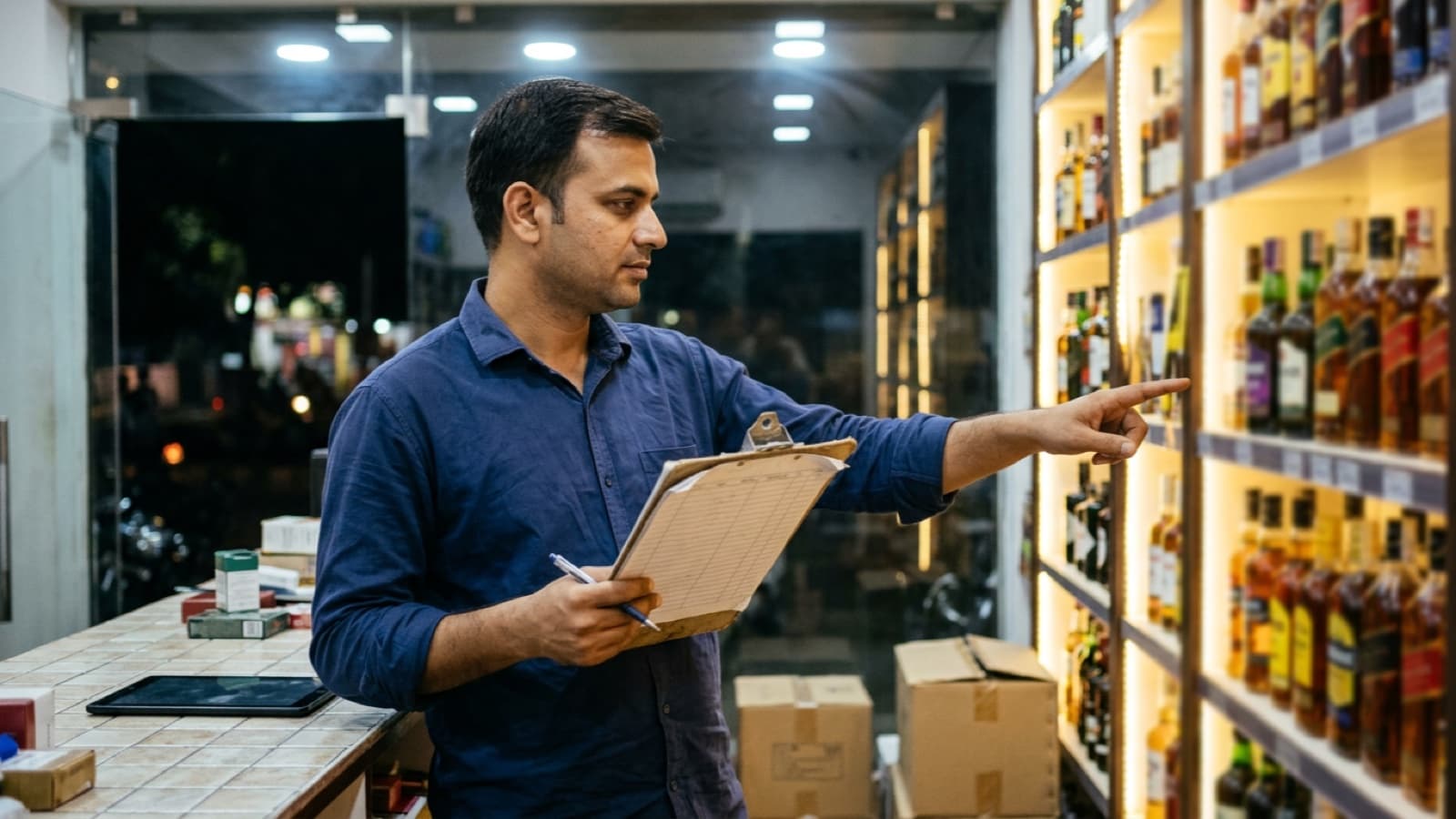
Liquor store theft prevention starts with a count, not with a suspect. It means knowing how many bottles are short, in which item and since which day, before you say a word to anyone.
Many owners never get that far. The shelf looks thin, someone says "maal kam hai", and the worry begins. You suspect a loss but you cannot put a number on it. That is what keeps you awake.
This post shows you how to size the shortage and find its cause. It is written for theka, composite and model shops in UP and for L-2 and L-14A vends in Haryana. Very often what you find is a record that went wrong, and a record can be fixed.
A shortage you cannot size is the real problem
A shortage is one simple sum. Take the stock you started with. Add what you received. Subtract what you sold, what broke and what you sent to another shop. That is the stock your books say you should have.
Now count the shelf and the godown. The difference between the two numbers is your gap.
The sum has five inputs: opening stock, purchases, sales, breakage and transfers. If any one of them is wrong, the gap is wrong. So a gap only tells you that the books and the shelf disagree.
Many shops check this once a month or once a year. By then the gap is one large number that nobody can explain, so somebody gets blamed for it.
Breakage makes it worse. In many shops a broken bottle is settled with the staff on the spot, so nobody writes it down. The bottle is gone from the shelf, and your books still count it.
Good wine shop inventory management keeps the five inputs current every day. The method below works on paper too.
Liquor store theft prevention: rule out four record errors first
When a shop owner tells us his stock is short, the same four causes come up again and again. Each one leaves a different mark in the numbers.
1. Wrong opening stock. The count on day one was wrong, or it was typed wrong. The mark: the gap stays the same size in every count.
2. A purchase that does not match what arrived. An invoice was never entered, so the shelf holds more than the books. Or a case came short against the invoice, so the shelf holds less. The mark: the gap is a round case quantity in one item, and it starts on a purchase date.
3. Bottles billed under the wrong item or the wrong pack size. In a rush, the 375 ml gets picked on the bill and the 750 ml goes over the counter. The mark: one item is short and its neighbour is over by the same number.
4. A price mapped to the wrong variant. The bottles match, but the cash does not match the bottles. The mark: the sale value is off by the same amount on every bottle of one item. In UP the excise department publishes the MRP for every brand and size, so each variant has one right price. In Haryana the department sets a minimum retail sale price, so check each variant against your own price list above that floor.
Two more causes sit behind these four.
Breakage that is claimed but not logged. The mark: small gaps across many items, with no date anyone can give.
Stock moved between shops without a record. The mark: one shop is short and the other is over by the same bottles.
A gap on paper is also an excise matter
The books can be wrong in both directions. The 2019 text of UP's foreign liquor retail rules lists a minimum compounding fee of Rs. 10,000 the first time a stock register is found incomplete. The fee is Rs. 25,000 the first time duty-paid stock is found in excess of the account. An invoice that was never entered creates exactly that excess.
In Haryana, the Excise Policy 2025-27 sets a penalty of Rs. 2,000 for each bottle of imported, bottled-in-origin whisky or wine found short at any licensed premises. Rules and amounts change, so confirm the current ones with your district excise office.
Run a count that isolates the gap
You need a count that shows where the gap is and when it began.
Count when the shop is shut. No billing and no receiving while the count runs.
Count by category: IMFL, beer, wine, and country liquor where you sell it. Inside each category, give every brand and size its own line.
Count the shelf and the godown separately, then add them.
Do not give the book figure to the person counting.
Write the book figure next to each counted figure. The difference on each line is the gap for that item.
Multiply each gap by the selling price and start with the biggest line in rupees.
Read the marks. Look for pairs that cancel, round case quantities, and gaps that have not changed since the last count.
Then find the day. Take the biggest lines and walk back to the last count that matched. For each day, opening stock plus bottles received minus bottles sold should equal closing stock. In UP the daily parcha already carries these figures. The day the sum stops working is the day to look at.
A worked example
These are round numbers made up to show the method. This is not a real shop.
The books say 4,000 bottles and the count says 3,978. The shop is short by 22 bottles, and that number explains nothing.
Line by line, the sheet shows this:
Whisky, one brand, 750 ml: short by 18
The same whisky, 375 ml: over by 18
Beer, one brand, 650 ml: short by 12
Vodka, one brand, 180 ml: short by 10
Rum, one brand, 750 ml: short by 6
Wine, one brand, 750 ml: over by 6
The whisky pair cancels. Eighteen bills carried the wrong pack size. No bottle is missing. Correct the bills and check the amount charged on each.
The beer is short by exactly one case. The last invoice says 20 cases, and nobody counted at the door. Call the wholesaler with the invoice number.
The vodka has been short by the same 10 bottles in every count for three months. That is the opening stock.
The wine is over by 6. A small invoice is lying in a file and was never entered.
The rum is the only gap without a mark. People remember bottles breaking in the godown, and nothing was written. So the open question is 6 bottles of one item, and you can ask about it with the sheet in your hand.
Check receiving at the door and keep a breakage log
Three habits stop most new gaps before they start.
Receiving. Count the cases against the invoice before the vehicle leaves. Check the brand and size on each case. A 375 ml case entered as 750 ml creates two wrong lines at once. Write the quantity received on your copy of the invoice. If a case is short, tell the wholesaler the same day. Enter the invoice the day the stock arrives.
Breakage. Keep one log at the counter or in the godown. Each line needs:
Date
Brand and size
Number of bottles
Where it broke: receiving, godown, shelf or counter
Who reported it
The initials of the owner or manager
Reduce the stock the same day. Log the bottle even when its cost is settled on the spot, because the shelf is one bottle lighter either way. Read the log once a week.
Haryana's excise policy gives wholesale vends a breakage allowance only when a proper record of the breakages is kept.
Transfers. When stock moves between two of your shops, write one slip with the items and quantities. Both shops sign it and both enter it the same day. Ask your district excise office what permission a transfer between two licensed shops needs.
Set the few controls that close the gaps
You need only a few controls, and they must run every day.
One login per person. Every bill then carries a name. This protects your staff as much as it protects you, because a clean record belongs to the person who kept it.
Owner approval for four things. These are discounts, bill cancellations, cash withdrawals and price changes. When you approve each one as it happens, none of them turns into an unexplained gap later.
A daily report you read yourself. It should show sales by category, purchases entered, breakage logged and the cash position. Two minutes on your own phone every night is enough.
A rotating count every night. Pick five to ten fast-moving items. Count them at closing and compare with the books. Change the items every night. A gap found this way is one day old and one item wide.
A camera shows you a moment. A record shows you a pattern. Shortage often builds slowly through small entries, and only a record shows that.
Give cash one short check
If the bottles match and the money does not, look at price mapping and payment mode first. A bill at the wrong price leaves the stock right and the galla wrong. So does a UPI sale entered as cash.
Our post on how to close the galla every night gives the full method for the nightly cash close.
How BottleShop keeps the books and the shelf matched
BottleShop is India's first liquor-only POS. As liquor store software, it keeps the five inputs of the stock sum current while the day runs.
Every bottle is billed at the counter in under one second, on an Android tablet. Billing works offline and syncs when the internet returns. Stock moves with each bill, so you know the live stock of every item. A physical count only confirms it.
Purchases are entered against the supplier invoice. Stock moved between your shops is recorded as a transfer. Cash drawer management gives you daily cash reporting, and one daily WhatsApp report comes to the owner's phone. All of this is in the Essential plan.
Every plan has unlimited users and logins. Each person gets their own login, and each bill carries it.
The Business plan fits an owner who is not at the counter all day. Discounts, bill cancellations, cash withdrawals and price changes come to your phone as a WhatsApp OTP and wait for your approval. It also sends WhatsApp alerts for low stock and stockouts. Plans start at Rs. 25,000 a year, about Rs. 70 a day.
In UP, the daily category-wise registers for IMFL, wine, beer 5% and beer 8% are built from the same billing. So is the monthly stock report.
BottleShop is live in 10 states with zero churn. The full list of what it does is on the features page.
Frequently Asked Questions
What is the first step in liquor store theft prevention?
Count the stock and compare it with your books, item by item. Do this before you suspect anyone. The count gives you the size of the gap, the items it sits in and the marks that point to its cause. Many gaps turn out to be a record error.
Why do my books show a shortage when no bottle is missing?
Often one of four records is wrong. The opening stock was entered wrong. A purchase invoice was not entered, or a case came short. Bottles were billed under the wrong item or pack size. Or a price sits on the wrong variant, so the cash does not match the bottles sold.
How often should a liquor shop count its stock?
Count five to ten fast-moving items every night and change the items daily. Do a full count by category at least once a month. A nightly count finds a gap when it is one day old and one item wide. A yearly count finds one large number that nobody can explain.
How should I record a broken bottle?
Write it in a breakage log the same day: date, brand and size, number of bottles, where it broke and who reported it. Have the owner or manager initial the line. Reduce the stock that day. Log it even if the cost is settled on the spot, because the bottle has left the shelf.
Is a stock gap a problem during an excise inspection?
It can be. The 2019 text of UP's foreign liquor retail rules lists a minimum compounding fee of Rs. 10,000 for an incomplete stock register and Rs. 25,000 for duty-paid stock in excess of the account. Haryana's 2025-27 policy penalises imported bottles found short. Confirm current amounts with your district excise office.
Stock milane ka sirdard ab khatam ho gaya. Message us on WhatsApp at +91 84473 30196 for a free inventory audit of your shop.
Last updated: 6 November 2026