Wine Shop Cash Counter: How to Close the Galla Every Night
Published By: Jatin Monga (CEO) on 03 Nov 2026
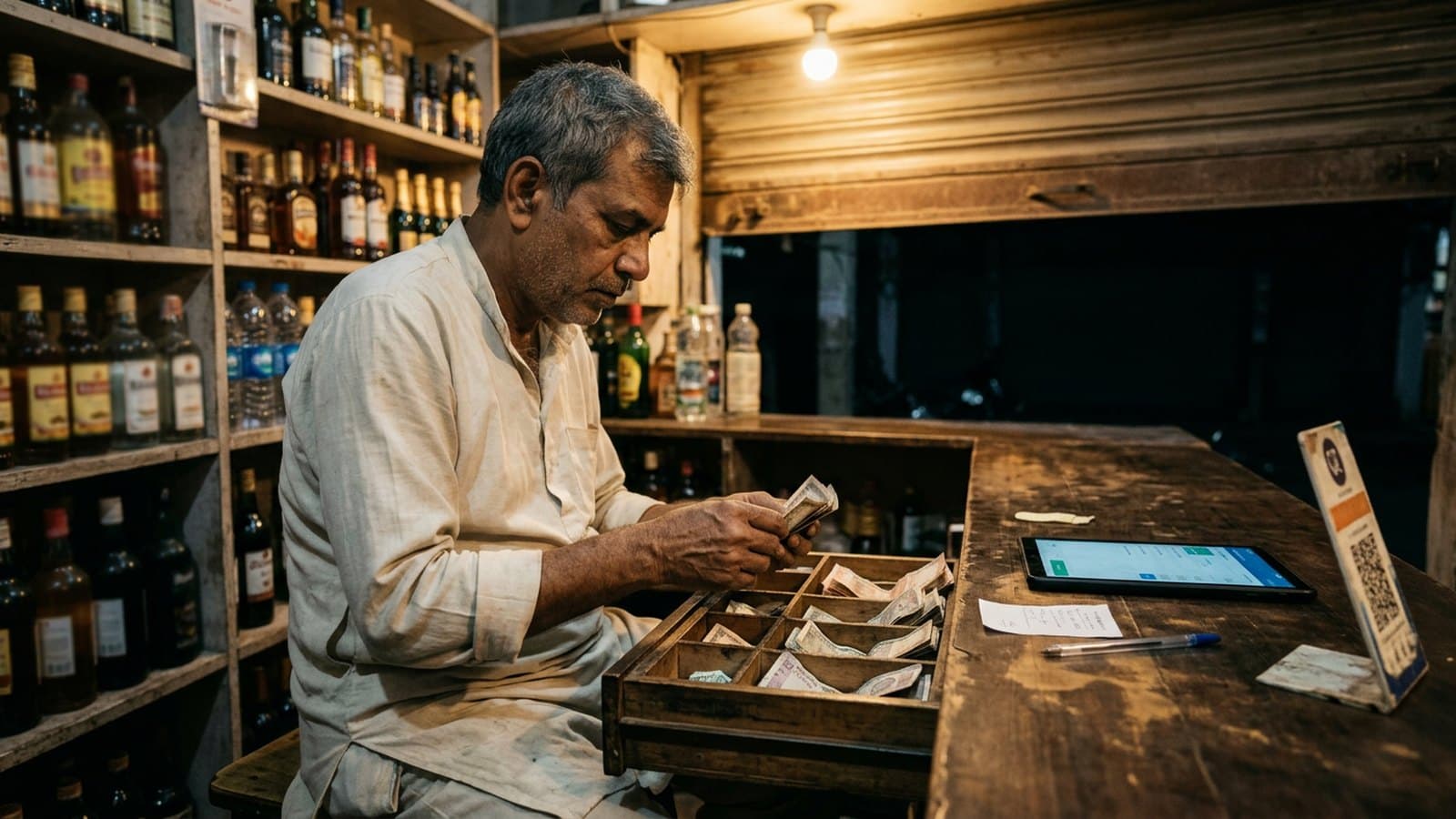
A wine shop cash counter is the galla drawer, the card machine and the UPI QR on the wall, all taking money for the same bills. Closing it means checking, every night, that the money in each of those places matches the sales for the day.
Most owners count the cash and stop there. The number looks fine, or a little short, and everyone goes home. The next night the same little gap is back, and nobody can say where it comes from.
This post gives you a fixed order for the nightly close. It shows you how to read the difference, and how to stop the same difference coming back.
Why the wine shop cash counter never matches on its own
Four kinds of money reach your counter. Cash goes in the galla. Card goes to the machine. UPI goes to the QR. Credit is a sale where no money came in at all.
If you only count the galla, you are checking one of the four. A UPI payment never touches the drawer. A credit bill never touches it either. So a drawer count alone cannot tell you whether the day was right.
The second problem is the order. Staff take cash out for a bank trip, for tea, for an owner pickup. If those moves are not written down at the time, the count at night has no way to explain itself.
A good theka billing software records each of these as it happens. Without it, you need a close that works on paper too, and the steps below do.
Close the galla in this order
Use the same order every night. The order matters because each step makes the next one possible.
Finish billing. Settle every open bill and note the closing time.
Count the cash in the galla before anything leaves it. Count twice, with a second person if you can.
List every rupee that left the drawer today: bank trips, owner pickups and small expenses. Write the reason next to each one.
List every rupee put into the drawer today apart from sales, such as change money from the owner.
Work out the cash you should have: opening balance, plus cash sales, plus cash put in, minus cash taken out, minus expenses.
Compare that with your count. The gap is your cash difference.
Check card against the card machine total for the day. Check UPI against the QR app or bank total. These are checked on their own. They are never added into the drawer.
Write down credit bills: who, how much, which bill.
Add cash, UPI, card and credit. The total must equal the total of the day's bills.
Only now take the night cash. Write the amount. What stays in the galla is tomorrow's opening balance.
Do the count before you take any night cash out. If you take it first, the count no longer matches the sum.
A worked example
These are round numbers made up to show the method.
The shop opened with Rs. 10,000 in the galla. The day's bills came to Rs. 90,000. They were paid like this:
Cash: Rs. 30,000
UPI: Rs. 50,000
Card: Rs. 8,000
Credit: Rs. 2,000
The four add up to Rs. 90,000, the same as the bills, so the split is right.
The owner put Rs. 5,000 of change money into the drawer. At 4 pm Rs. 10,000 went to the bank. Rs. 1,000 was paid out for expenses.
The cash you should have is 10,000 plus 30,000 plus 5,000, minus 10,000, minus 1,000. That is Rs. 34,000.
If the count is Rs. 34,000, the difference is zero. If the count is Rs. 33,500, the drawer is short by Rs. 500, and you go looking for a Rs. 500 reason.
Say you keep Rs. 10,000 in the galla each morning. After a count of Rs. 33,500, the night cash is Rs. 23,500 and Rs. 10,000 stays as tomorrow's opening balance.
Read the difference before you blame anyone
A difference is information. Its size and its pattern point to a cause. Check these in order.
The difference equals your UPI total, to the rupee. This is almost never missing cash. It is a sum with a payment mode on the wrong side.
Take the example above with a count of exactly Rs. 34,000. Someone adds the Rs. 50,000 UPI into the cash you should have and gets Rs. 84,000. The sheet now shows Rs. 50,000 short. Nothing is missing from the galla. The sum was wrong. The same happens with card. Remove the digital modes from the cash sum and the gap disappears.
The difference equals one bill. A sale may have been entered under the wrong mode, such as cash typed in for a UPI payment. Or a bill was cancelled after the money was already in the drawer. Look at the day's bills of that exact amount.
The difference is small and different every night. This is usually change. In a rush, a customer gets Rs. 50 or Rs. 100 too much or too little. Small and random gaps are a counting and speed problem, not a trust problem.
The difference goes the same way every night. A drawer that is short every night by a similar amount points to method. Maybe an expense is not being written down. Maybe the opening balance is a guess.
The drawer is over. Cash may have been put in without a note. Or a customer paid an old credit bill and it was entered as a fresh sale.
Everything matches but the modes do not add up to the bills. If cash, UPI, card and credit come to less than the bills, a discount may be missing or a bill may have been entered under the wrong mode. Go through the bills for the day.
Most differences are mistakes and method. Treat them that way. Staff who feel accused stop being open about small errors, and small errors are how you find the big ones.
Stop the same difference coming back
A close tells you what happened. These habits change what happens tomorrow.
Fix the opening balance. Decide a number and leave exactly that in the galla each morning. A guessed opening balance breaks every close that follows.
One person on one drawer. If two people share a galla, a difference has no owner. One cashier per drawer per shift makes it traceable.
Write cash out at the moment it leaves. Amount, time, reason. A note made in the evening from memory is not a record.
Close at the same time every night. A close done one day at 10 pm and the next at noon the next day compares different things.
Name your machines and QR codes. If you have two card machines or two QR codes, track each one by name. A single combined number hides which one is off.
Look at the difference the same night. A gap seen the next morning is much harder to trace, because the bills and the memory are both a day old.
One chain owner in our network does this in a simple way. Staff at each shop post one message on a WhatsApp group every night. It gives the cash in hand, the UPI, the card and the sales as the system shows them. The owner sees how far apart those numbers are, shop by shop, every day. The question gets asked every day.
How BottleShop closes the counter for you
BottleShop is built so that the close above is a screen, not a notebook. Here is how each step maps to it.
When a cashier logs in, the system asks for the opening balance, the cash in the galla. Billing then runs at under one second a bill. You set up each counter, name every card machine and QR code, and link each machine to its counter.
At night, the cashier closes the counter in one step. Cash taken out is written against the close, so the count and the sum do not clash. The shop gets its daily cash reporting from the system rather than from someone's memory.
This sits in the Essential plan, which includes cash drawer management and daily cash reporting. Plans start at Rs. 25,000 a year, about Rs. 70 a day.
If you are not at the shop every night, the Business plan adds owner approvals. A cash withdrawal or a bill cancellation goes to your phone as a WhatsApp OTP, and it does not go through until you approve it. These OTP messages carry a small usage charge, which is listed on the pricing page.
Everything else the system does is on the features page. It works offline and syncs when the internet returns. If you want to see your own nightly close on a screen, ask for a demo and bring last night's numbers.
Frequently Asked Questions
How do I know the right cash amount for my wine shop cash counter at night?
Start with the opening balance. Add the day's cash sales and any cash put into the drawer. Subtract cash taken out and expenses paid from the drawer. Do not add UPI or card. That total is what the galla should hold. Count the drawer before any night cash leaves it, then compare.
Why is my cash short by exactly my UPI total?
Almost always the sum is wrong, not the drawer. UPI money goes to your bank, not to the galla. If the UPI total was added into the cash you should have, the sheet will show a shortage equal to it. Remove UPI from the cash sum and check the count again.
Should card and UPI be checked at night too?
Yes, each on its own. Compare card sales with the card machine total for the day. Compare UPI sales with the QR app or bank total. Never mix them into the cash count. If either does not match, look for a bill entered under the wrong payment mode.
What should I do if the cash is short by a small amount every night?
First check that your opening balance is a fixed number and not a guess. Then check that every expense and bank trip is written down. If the gap is still small and random, it is usually change given in a rush. Watch the pattern for a week.
Can I take night cash home before I count the drawer?
Count first, then take the night cash. If you take it out before counting, the count and the sum will not agree, and you will get a false gap equal to the cash you took. Write the night cash amount down. The cash left is tomorrow's opening balance.
Can I close the counter without software?
You can. A notebook with the steps above works if it is done at the same time every night and every cash move is written as it happens. Software helps because it records each move at the time, so the close is a check and not a reconstruction.
Last updated: 3 November 2026