Wine Shop Stock Register Format for UP and Haryana Shops (2026)
Published By: Jatin Monga (CEO) on 03 Oct 2026
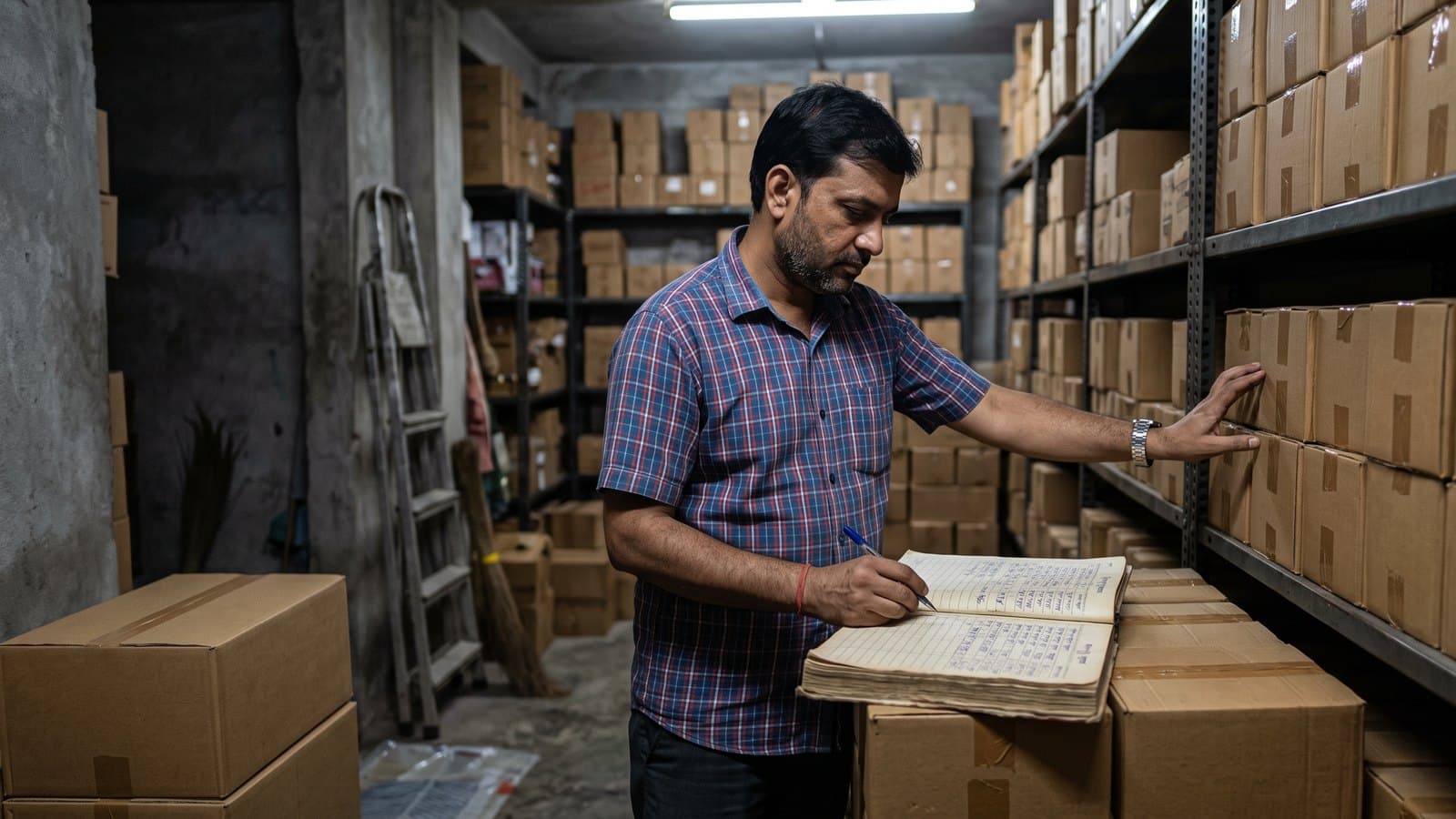
A stock register is the daily record of every bottle that comes into your shop and every bottle that goes out. The excise inspector reads it against your shelf, and the two must match. In Uttar Pradesh and Haryana, the rules ask for this account every day.
The trouble starts small. One purchase entry is missed on a busy evening. One case of 375 ml is written on the 180 ml line. A week later the register says 40 bottles and the shelf holds 31. Nobody can say where the gap came from.
This guide gives you a wine shop stock register format you can use from tomorrow. It covers what UP and Haryana expect, how often to write it, and why hand registers drift. It also shows how wine shop inventory management software keeps the register exact.
The registers a UP shop keeps
UP splits the register by category. The IMFL register holds all spirits, and imported liquor goes in it too. Wine has its own register. Beer has two, one for 5% (mild) and one for 8% (strong). A composite shop keeps the registers for what it sells. A country liquor shop keeps its own.
The UP foreign liquor retail rules ask for "a regular and accurate daily account". It goes in the form and register the licensing authority prescribes. The 2019 rule text names that form FL-25A. The account is uploaded on the excise portal and shown to any inspecting officer who asks. The country liquor rules carry the same condition. In most UP shops, the daily working sheet behind all this is the parcha.
UP also adds a digital check. Every bottle sold is scanned on the OASYS device. Purchases come in by scanning the QR code on the invoice. Each month the shop files its closing stock, the MST. That filing shows how many bottles came in and how many were scanned out. Shops are now expected to keep scan coverage above 90%. Repeated misses put the licence at risk.
The stakes are written into the rules. UP's country liquor retail rules set a compounding fee of Rs. 10,000 when a stock register is not produced or is found incomplete. It rises to Rs. 15,000 the second time and Rs. 20,000 the third. Ask your District Excise Officer for the exact form your licence type uses.
The registers a Haryana shop keeps
Haryana's base rules are the Haryana Liquor Licence Rules, 1970. Every licensee must keep the registers prescribed for his class of business. Accounts must be "true and correct" and written day to day in ink, with figures in English numerals. When the licence ends, the registers go to the Deputy Excise and Taxation Commissioner (DETC) of the district.
An L-2 vend selling IMFL keeps Register Form L-22. Every receipt is entered against the number and date of its pass. Quantities are in bulk litres, split by kind:
Imported whisky, brandy, rum and gin
Indian whisky, brandy and gin
Indian coloured rum
Other spirits and liquor
Imported wine and Indian wine
Beer
An L-2 vend enters its sales as daily totals. At the end of each day, the day's totals go in and the balance is written below them. The monthly return to the Excise Inspector carries the month's totals and the closing balance.
A country liquor vend under L-14A keeps Register Form L-26. It records receipts with the pass number, then sales and balance. Bottles are counted in 750 ml, 375 ml and 180 ml, in dozens and bottles.
The Haryana Excise Policy 2025-27 adds two points. Clause 1.7 makes a POS machine mandatory at the counter of every retail vend, with an invoice on demand. It also asks licensees to adopt the integrated POS solution the department prescribes. Ask your DETC (Excise) office what that covers for your vend. Clause 9.5.8 fines Rs. 3,000 for every unaccounted bottle of imported whisky or wine (IFL BIO) found at a vend. A bottle of it found short costs Rs. 2,000.
A sample stock register format
Here is a wine shop stock register format that works for any category. Keep one page per category. Give every brand and every size its own line, because a 750 ml and a 180 ml are different stock. Use these columns:
Date
Brand
Size in ml
Opening stock, in bottles
Received today, with the pass or invoice number
Sold today
Breakage, with a short reason
Closing stock
Remarks, and the officer's signature when he inspects
Haryana's L-22 also wants each quantity in bulk litres. The official form your office issues may carry more columns. Follow its layout, and use these columns as your daily working sheet.
Here is one day on an IMFL page in UP, for one whisky (Brand A) in three sizes.
Date: 1 October 2026. Category: IMFL.
Brand A, 750 ml: Opening 120, Received 48, Sold 61, Breakage 0, Closing 107
Brand A, 375 ml: Opening 96, Received 0, Sold 40, Breakage 1, Closing 55
Brand A, 180 ml: Opening 300, Received 192, Sold 233, Breakage 0, Closing 259
Every line passes one test. Opening plus received, minus sold, minus breakage, equals closing. For the 750 ml line, 120 plus 48 is 168. Take away 61 and you get 107.
The next day, the 750 ml line opens at 107. Never at a rounded figure or one from memory.
For Haryana's L-22, convert bottles to bulk litres before you add the day's total. 107 bottles of 750 ml make 80.25 litres.
How often to update the register
Both states ask for the account every day. This routine keeps you there.
Write the day's sales and closing for every line at closing time.
Enter every purchase on the day it arrives, with the pass number.
Record breakage on the day it happens. Ask your excise office how they want it shown.
Count the fast-moving brands on the shelf every week.
Count the whole shop before the monthly filing.
File the month: the MST in UP, the monthly return to the Excise Inspector in Haryana.
Why hand registers drift from the shelf
A hand register drifts in small steps. Each one looks harmless on the day.
Missed purchase entries
Stock arrives at 8 pm, in the middle of the rush. The pass goes into the drawer and never reaches the register. Now the shelf holds more than the register shows. Those extra bottles look like stock with no source.
Wrong pack size
A case of 375 ml gets written on the 180 ml line. Now two lines are wrong. One shows excess and the other shows a shortage. The same happens at the counter when a 180 ml is billed as a 375 ml.
Breakage nobody writes down
A bottle breaks in the godown. It goes in the bin, not in the register. The register keeps counting a bottle that no longer exists. Ten such bottles a month make a shortage the inspector will ask about.
One wrong closing, carried forward
A tired hand copies 170 instead of 107 as the next day's opening. Every day after that is wrong by 63. Nobody notices until the next count.
When the register and the shelf disagree, find the gap in this order. Count the shelf and godown by brand and size. Check the last month of passes against the received column. Then compare size lines in pairs: 750 against 375, and 375 against 180. Do not overwrite old entries. Write a dated note and ask your excise office how to show the correction.
How billing software keeps the register exact
Every error above starts with someone copying a number by hand. The fix is to stop copying. When every bill and every purchase entry writes the register, nothing is missed.
BottleShop is India's first liquor-only POS. This is what it does for your register:
Each bill takes the exact brand and size out of stock. Billing takes under a second, so the counter keeps up in the evening rush.
Each purchase entry adds stock against the brand, size and invoice. Stock transfers between your shops are their own entry.
For UP, the daily category registers (IMFL, wine, beer 5% and beer 8%) and the monthly MST report are built from billing.
For Haryana, the stock and sales reports show each day's movement by brand and size. Your accountant fills the L-22 or L-26 from numbers that match the shelf.
It runs on an Android tablet, in full offline mode, and syncs on its own when the internet returns.
At setup, your opening stock is entered from your paper records.
The owner gets a daily report on WhatsApp.
The Essential plan covers billing, purchase entry, stock, the cash drawer and compliance reports on one billing device. Plans start at Rs. 25,000 a year, about Rs. 70 a day. BottleShop is live in 10 states with zero churn. You can see the full feature list before you call us.
Frequently Asked Questions
What is a good wine shop stock register format?
Give each brand and size its own line. Record the date, brand, size in ml, opening stock, bottles received with the pass number, bottles sold, breakage and closing stock. Add a remarks column for the inspecting officer. Keep one page per category. Haryana's L-22 register also asks for quantities in bulk litres. Confirm the exact form with your excise office.
How often must a UP liquor shop update its stock register?
Every day. The UP retail rules ask for a regular and accurate daily account in the register the licensing authority prescribes, uploaded on the excise portal. Write it at closing, and enter purchases on the day stock arrives. Count the shelf before the monthly closing stock filing. A register that runs days behind will not survive an inspection.
Which stock register does a Haryana L-2 vend keep?
The Haryana Liquor Licence Rules, 1970 prescribe Register Form L-22 for L-1 and L-2 licensees. It records each receipt against its pass number and date, sales as daily totals, and every quantity in bulk litres. Country liquor vends under L-14A keep Form L-26. Accounts are written day to day in ink, with a monthly return.
Why does my stock register not match the shelf?
Usually it is one of four things. A purchase was never entered. A case went on the wrong pack size line. A broken bottle was never recorded. Or one wrong closing figure was copied forward as the next opening. Count the shelf, check the last month of passes, and compare size lines in pairs to find it.
What happens if the stock register is incomplete during an inspection?
In UP, the country liquor retail rules set a compounding fee of Rs. 10,000 the first time a stock register is found incomplete. It rises to Rs. 20,000 by the third time. In Haryana, the 2025-27 policy fines Rs. 3,000 for each unaccounted bottle of imported whisky or wine found at a vend. Check the rules for your licence type.
Can billing software keep the stock register for me?
Yes, if it records stock from every bill and every purchase. BottleShop takes the exact brand and size out of stock on each bill and adds stock on each purchase entry. For UP, it builds the daily category registers and the monthly MST from billing. Your excise office still decides the final form of the register.
Last updated: 3 October 2026