Wine Shop Inventory Management: The Complete Guide for Indian Retailers (2026)
Published By: Jatin Monga (CEO) on 15 Apr 2026
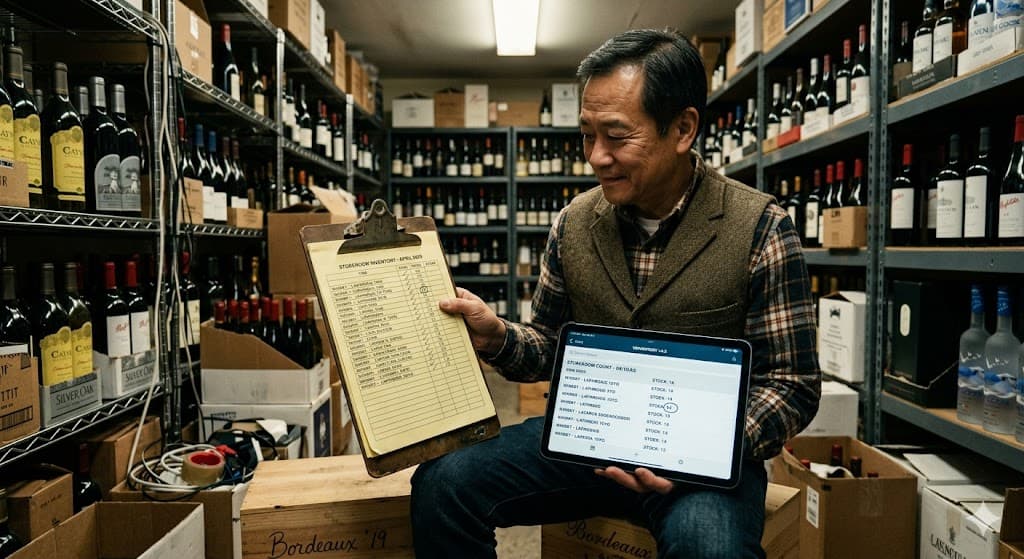
Wine Shop Inventory Management: The Complete Guide for Indian Retailers (2026)
Inventory is where most liquor store money is made or lost. Not at the counter — in the storeroom, in the ordering decisions, in the dead stock sitting on shelves for 60 days.
\---
Why Inventory Management Is Different in Liquor Retail
\- MRP is fixed — you cannot increase margin by pricing up
\- State excise compliance — every bottle must be recorded
\- Brand proliferation — a well-stocked IMFL shop carries 400–600 active SKUs
\- Seasonal demand swings — 2–4x spikes during weddings, festivals, tourist season
\- Distributor minimum orders — cannot always order exactly what you need
\---
The 5 Inventory Metrics Every Wine Shop Must Track
1\. Stock on Hand — Real-time count of every SKU
2\. Daily Sales Velocity — Units per SKU per day on average
3\. Days of Stock Remaining — Stock on hand divided by daily velocity
4\. Dead Stock — SKUs not sold in 30+ days
5\. Gross Inventory Value — Total current stock value (typically ₹8–30 lakh for mid-size shops)
\---
Receiving Stock: The Most Overlooked Step
Most inventory errors start at the receiving dock. When a distributor delivery arrives:
1\. Count every case and unit before signing the challan
2\. Verify brands against the purchase order
3\. Check for damaged or broken bottles — record immediately as breakage
4\. Enter the delivery into your stock system the same day
5\. File the challan — proof of purchase for excise compliance
Signing a challan without verifying is the single most common source of stock register discrepancies.
\---
Ordering: Data Over Gut Feeling
A data-based ordering process:
1\. Look at the last 30 days of sales per SKU
2\. Calculate average daily sales per SKU
3\. Check current stock on hand
4\. Calculate days of stock remaining
5\. For any SKU with less than 5 days remaining — reorder
6\. Apply seasonal multiplier for upcoming peaks
BottleShop's AI Purchase Upload does all of this automatically.
\---
Dead Stock: How to Find It and What to Do
Dead stock is any SKU not sold in 30+ days. In a 400-SKU store, it is common to have 60–80 dead SKUs at any time.
What to do:
\- Stop reordering immediately
\- Talk to your distributor about return or exchange
\- Identify if another chain location might move this SKU
\- Liquidate at MRP rather than hold indefinitely
\---
Seasonal Inventory Planning
UP — Wedding Season (November to February): Order 30% more premium whisky, rum, beer in October.
Goa — Tourist Season (October to March): 40–50% higher safety stock on premium categories from September.
Pan-India — Diwali and Holi: Order 6 weeks before the festival, not 1 week.
\---
How BottleShop Manages Inventory
\- Real-time stock update with every transaction
\- Hero item tracking
\- Low stock alerts — push notifications before stockout
\- Dead stock identification — auto-generated weekly list
\- AI Purchase Upload — recommended order per SKU
\- Multi-store inventory — all locations on one screen
> 500+ stores use BottleShop across India. Setup in 2 hours.
\---
Frequently Asked Questions
How many SKUs does an average Indian wine shop carry?
Small counter/theka: 50–150 SKUs. Mid-size IMFL shop: 200–400. Premium walk-in or chain: 400–700+.
How often should I do a physical stock count?
Monthly full count and weekly spot checks on hero items.
What is the biggest inventory mistake wine shop owners make?
Ordering based on shelf appearance rather than data.
How does AI Purchase Upload work in BottleShop?
It analyses your last 30–90 days of sales per SKU, calculates current stock, and generates a recommended order list.