How to Open a Wine Shop in India: Complete 2025 Guide (License, Investment, Operations, Software)
Published By: Jatin Monga (CEO) on 13 Apr 2026
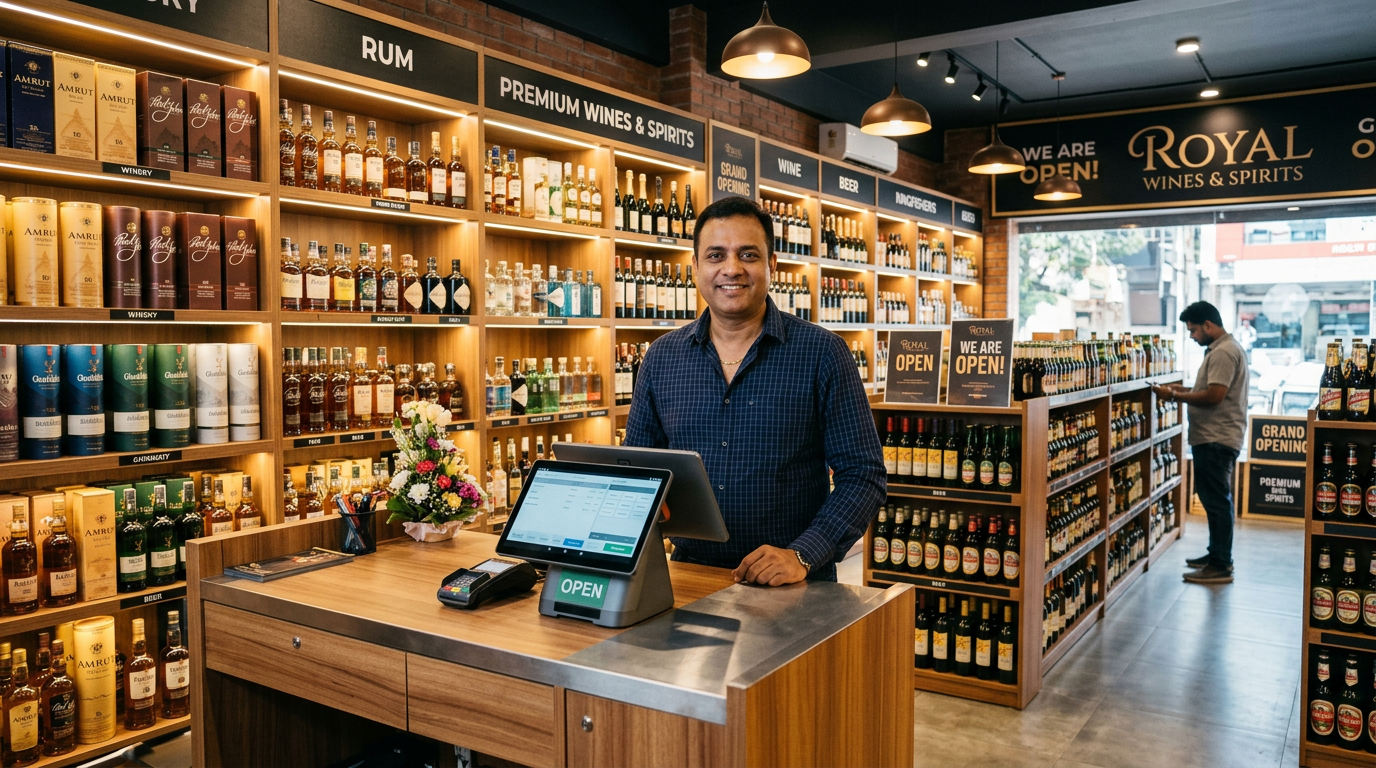
Opening a wine shop or liquor store in India is one of the most profitable retail businesses you can set up — but it is also one of the most regulated.
Most guides online cover how to get the license. Very few cover what to do after: how to set up operations, what the real costs are, how to manage stock and billing from Day 1, and what mistakes new shop owners make in the first 90 days.
This guide covers the complete journey — from deciding your license type to running a profitable, compliant shop.
Step 1: Understand the Regulatory Landscape in Your State
Alcohol regulation in India falls under the State List of the Constitution. Every state has its own excise policy, license types, pricing structure, and compliance requirements.
Before anything else, confirm the current status in your state:
- Is private retail allowed? (Bihar, Gujarat, Nagaland, Mizoram have prohibition)
- Is the state under a government monopoly (Tamil Nadu TASMAC, AP APBCL) or private retail?
- What formats are available — country shop, model shop, IMFL retail, composite?
- What is the current annual license fee for your target format and district?
- Are new licenses being issued this year, or is it a lottery/tender cycle?
This research takes 1–2 days and saves months of wasted effort.
Step 2: Choose Your Shop Format
Country Liquor Shop (Theka) Sells desi sharab and beer. Highest volume, lower margin per unit. Fast counter billing. Common in UP, MP, Rajasthan, Bihar.
IMFL Retail (FL-2 / Wine Shop) Sells whisky, rum, vodka, gin, beer, and imported liquor. Better margins. Requires managing 400–800 active SKUs. Common in urban and semi-urban areas.
Model Shop / Premium Retail Government-approved premium format. Higher infrastructure standard. Available in UP, Rajasthan, Haryana.
Composite Shop Both country liquor and IMFL from the same premises. High volume, complex inventory.
Step 3: Calculate Your Real Investment
- License fee: ₹2 lakh to ₹15 lakh depending on state, format, and district
- Security deposit: ₹50,000 to ₹3 lakh (refundable)
- Shop fit-out: ₹2 lakh to ₹8 lakh (shelving, counter, signage, refrigeration)
- Opening inventory: ₹5 lakh to ₹20 lakh depending on format and state
- POS and billing software: ₹15,000 to ₹50,000 annually
- First month working capital: ₹50,000 to ₹2 lakh
Total realistic range: ₹12 lakh to ₹50 lakh depending on format, state, and city.
Insight from BottleShop data: The average liquor store with good operations recovers its setup investment within 8–14 months. Stores with poor inventory management take 24+ months or never break even.
Step 4: Get the License
General process across most states:
1. Visit your State Excise Department website or office and confirm license availability 2. Identify the correct license type for your format and location 3. Assemble documents: identity proof, address proof, premises documents, NOCs, affidavits 4. Submit the application with documents and fees 5. Premises inspection by excise officials 6. Public notice period (7–30 days depending on state) 7. License issued after fee payment and security deposit
Timeline: typically 30–90 days. In tender-based states like UP, licenses are issued on a fixed annual cycle — missing the window means waiting another year.
Step 5: Set Up Your Operations Before Opening Day
Choose approved distributors immediately Every state has a list of excise-approved distributors. Get this list from your District Excise Office and establish relationships before opening.
Set up your billing system before your first customer walks in A paper register will not survive your first month. Every sale, every purchase, every stock movement needs to be recorded — for excise compliance, for tax, and for your own profit calculation.
The stores that set up digital billing on Day 1 never have the audit problems that stores using manual registers eventually face.
Understand your state compliance obligations Know before you open: what reports are due monthly, what your stock register format must look like, and what happens during a surprise excise inspection.
Step 6: Manage Inventory from Day 1
Inventory management is the single biggest driver of profit or loss in a liquor store. The stores that grow quickly are not the ones with the best location — they are the ones with the sharpest inventory decisions.
- Order what sells — not what looks attractive in the distributor catalogue
- Track every SKU individually — not just total stock value
- Identify dead stock within 30 days
- Maintain a low-stock alert system — bestseller stockouts during peak hours lose customers permanently
- Reconcile every distributor delivery against your purchase order immediately
What Software Do Successful New Wine Shops Use?
BottleShop is India's first liquor-only POS, used by 500+ stores across 10 states. For new shop owners:
- Setup in 2 hours — live on opening day
- Auto-generated stock register — excise-compliant from the first transaction
- State compliance built in — UP MST, Maharashtra SCM, Goa VAT and more
- AI inventory intelligence — dead stock, slow movers, low stock alerts
- Sub-1-second billing — zero queue at rush hour
- Galla management — cash under control from Day 1
- Runs on Android tablet — no expensive hardware
Frequently Asked Questions
How much does it cost to open a wine shop in India? Between ₹12 lakh and ₹50 lakh total. License fee is the biggest variable — ₹2 lakh in small districts to ₹15 lakh in metro areas.
Is opening a wine shop profitable in India? Yes. Well-managed stores typically recover investment in 8–14 months. Key variables: location, stock management, and compliance.
Which states are easiest to get a wine shop license? UP, Rajasthan, Haryana, Goa, and Maharashtra have active private retail with available license formats. Avoid prohibition states — Bihar, Gujarat, Nagaland.
Do I need software on Day 1? Yes. Your excise stock register must be accurate from your first transaction. BottleShop can be set up the same day you open.
Can one person run a wine shop? Single-operator shops are common, especially thekas. With good software, one person can manage billing, stock, and compliance with minimal overhead.