Cash Leakage in Indian Liquor Stores: Where the Money Goes and How to Stop It
Published By: Jatin Monga (CEO) on 13 Apr 2026
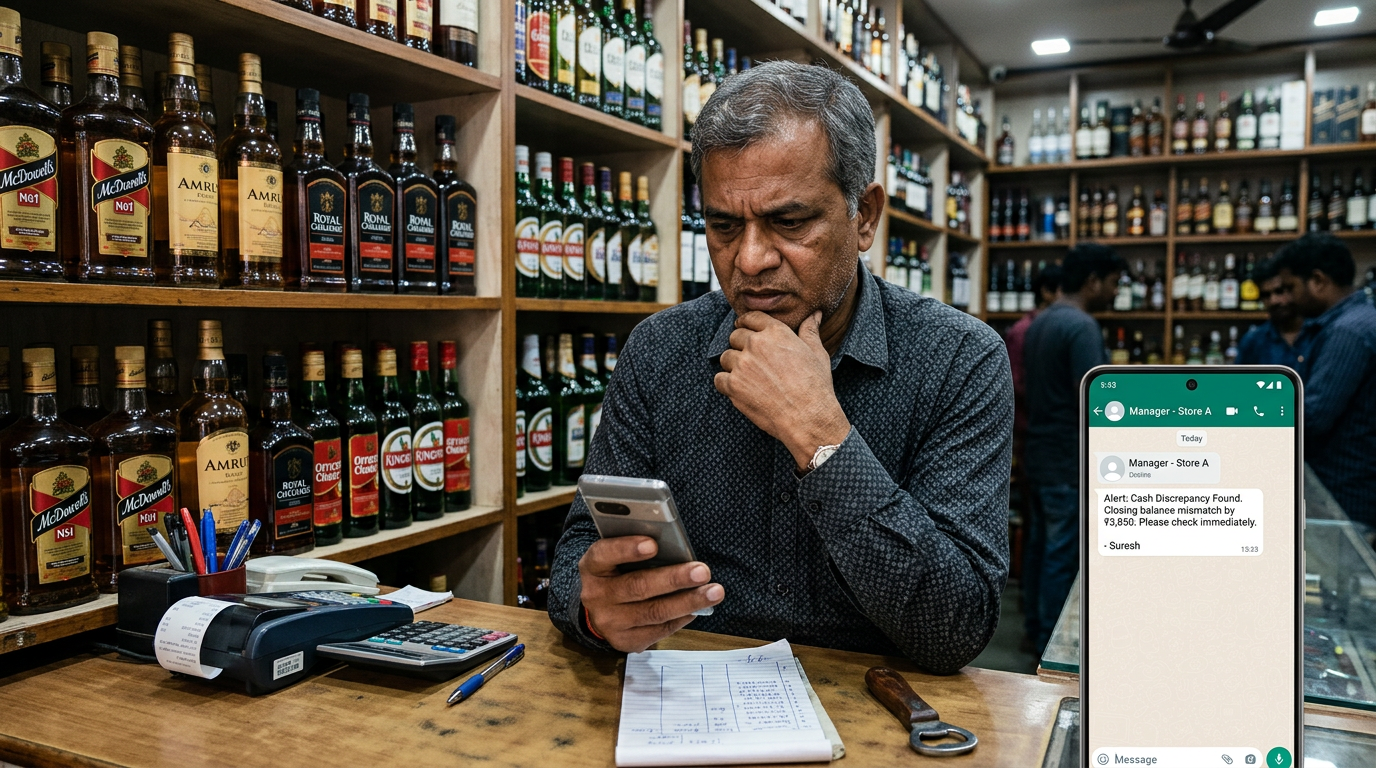
A liquor store owner we spoke to once said: "Mera store achha chal raha hai — sales bhi hain, customers bhi hain. Phir bhi mahine ke end mein paisa nahi bachta."
This is one of the most common problems in Indian liquor retail. And in most cases, the answer is not low sales — it is cash leakage.
What Is Cash Leakage?
Cash leakage is the gap between what your store should have earned and what actually ends up in your hands at the end of the day or month.
It is not always theft. It comes from multiple sources — some intentional, some accidental, some structural.
The 6 Main Sources of Cash Leakage in Liquor Stores
1. Unrecorded discounts A customer asks for ₹50 off. The staff member gives it without entering it into the system. Multiplied by 20 transactions a day, that is ₹1,000 daily — ₹30,000 a month — gone with no record.
2. Unrecorded refunds A return or exchange happens at the counter. The cash goes back to the customer. The system is never updated. The stock comes back in, the cash goes out, and neither is tracked.
3. Cash drawer shortages At end of shift, the cash in the drawer does not match what the system says should be there. Without a structured reconciliation process, this gap gets absorbed as "it happens."
4. Staff billing errors Billing the wrong product, billing a lower MRP, or skipping a line item by mistake. At 200+ transactions a day, these errors add up.
5. Free samples or informal giveaways Bottles that leave the store as "samples" for regular customers or favours — not entered as sales or losses anywhere.
6. Petty cash misuse Small cash withdrawals for "expenses" — tea, auto, cleaning — that never get logged. Each one is small. Together they become significant.
Why Liquor Stores Are Especially Vulnerable
Most transactions are cash. High volume means high transaction frequency. Rush hour creates pressure that makes corners easy to cut. And the owner is rarely physically present at the counter during every shift.
This combination — high cash, high volume, owner absent — creates the ideal conditions for leakage to go undetected for months.
How BottleShop Controls Cash Leakage
BottleShop has a complete Galla (cash drawer) management system built specifically for this:
- Opening cash set per shift — every shift starts with a declared opening balance
- Live expected cash by payment mode — cash, UPI, card tracked separately in real time
- Day-end tally — expected vs. counted, with shortage or excess clearly flagged
- OTP-verified withdrawals — any cash taken from the drawer requires OTP authorisation and a logged reason
- Owner WhatsApp alerts — any discount above a threshold, any refund, any cash limit breach triggers an instant WhatsApp message to the owner
- Discount controls — discounts above set limits require manager approval
With BottleShop, an owner who is not physically present at the store still knows exactly what is happening at the counter — in real time.
Store owners on BottleShop report discovering and stopping leakage they had been absorbing unknowingly for months.
What to Do If You Suspect Cash Leakage in Your Store Right Now
1. Count the cash in your drawer against what your billing system says — today, unannounced 2. Check the last 30 days of discount entries — are they reasonable? 3. Check refund entries — do they match actual returns? 4. Compare daily cash totals with daily sales reports for the last month 5. If gaps exist and you cannot explain them, you have leakage
The first step is visibility. The second step is controls.
Frequently Asked Questions
How much cash leakage is normal in a liquor store? None is normal — it is all preventable. Stores without controls often lose ₹15,000–₹80,000 per month through cumulative small leakages.
Is cash leakage always theft? No. A large portion comes from billing errors, unrecorded discounts, and informal practices rather than deliberate theft.
How does BottleShop prevent cash leakage? Through real-time Galla management, OTP-verified withdrawals, owner WhatsApp alerts, and end-of-shift expected vs. counted reconciliation.
Does BottleShop work if internet is down? Yes — pure offline mode. All Galla controls work offline. Data syncs when connection returns.